วันศุกร์ที่ 10 กุมภาพันธ์ พ.ศ. 2555

งานพิเศษ

สรุป
a lot
จริงๆ แล้ว ควรจะใช้ a great deal of หรือ much (ใช้กับนามนับไม่ได้) หรือ
a large number of หรือ many (ใช้กับนามพหูพจน์) แทนซึ่งเป็นคำที่ทางการกว่า เช่น
A large number of books are on the table.
A great deal of milk is left in your glass.

a little
-   ใช้นำหน้าคำนามนับไม่ได้เอกพจน์ เช่น
จำนวนของสิ่งของที่มีปริมาณ หรือนไม่สามารถบอกจำนวนที่แน่นอนได้
a little money a little sugar a little knowledge a little respect
I have a little money, I can lend you some.
Please give me a little sugar
any 

ใช้กับ ประโยคปฏิเสธ ใช้ได้ทั้งกับนามนับได้และนามนับไม่ได้ แต่ความหมายจะเปลี่ยนเป็น

"ไม่ ______ เลย" เช่น

I don't have any pens. (ฉันไม่มีปากกาเลยสักด้าม)
some 

ใช้กับประโยคบอกเล่า ใช้ได้ทั้งกับนามนับได้และนามนับไม่ได้ 

เช่น
I have some pens. (ฉันพอจะมีปากกาบ้าง)

John wants some water. (John ต้องการน้ำบ้าง)

There are some books on the table. (มีปากกาอยู่บนโต๊ะบ้าง)

There is some sugar in the bowl. (มีน้ำตาลทรายอยู่ในชามบ้าง)

Much  
 ใช้ขยายคำนามที่นับไม่ได้ นิยมใช้ในประโยคปฏิเสธ ประโยคคำถามและหลังคำ  How, too, so, as เช่น
  How much tea have you?
  He has not much sugar.
  He drinks so much beer that he gets fatter.    


a few and few นั้นใช้กับ นามนับได้ เช่น

I have a few friends.

I have few friends.

2 ประโยคนั้นหมายถึง ฉันมีเพื่อนไม่มากนัก เหมือนกัน 

แต่ ประโยคแรกนั้นจะแสดงให้เห็นว่า ถึงแม้ว่ามีเพื่อนไม่มากแต่ก็ไม่ได้มีอะไร คือ มีเพื่อนน้อยแต่ก็พอใจ

แต่ ประโยคที่สองนั้น เป็นการแสดงให้ ฉันมีเพื่อนน้อยจัง คือแบบไม่พออ่ะ ฉันอยากมีเพื่อนมากกว่านี้ ประมาณนั้น



วันพุธที่ 28 ธันวาคม พ.ศ. 2554

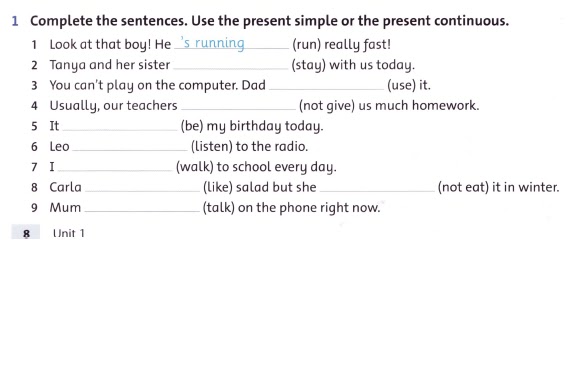
งานชิ้นที่ 1


ข้อ 2 - stays  เพราะเป็น เพรเซนท์ ซิมเปอร์ ประธานเอกพจน์บุรุษที่ 3 + กริยาช่อง 1  เติม s
ข้อ 3   -ใช้ is เพราะ ประธานเป็นเอกพจน์ บุรุษที่ 3 รูปประโยคเป็น Present Con V. เติม ing
ข้อ4 - not gives เพราะ เป็นประโยคที่แสดงเงื่อนไขว่าไม่ให้ และประธานเอกพจน์บุรุษที่ 3
ข้อ 5  - เติม ing   เพราะ  เป็น เพรเซนท์ คอน กิริยา V1
ข้อ 6  - ประธานเป็นเอกพจน์ บุรุษที่ 3 เป็น Present Simple กริยาเติม s 
ข้อ7  - Walks  เพราะ ประธานเป็นเอกพจน์ v.1 เติม s
ข้อ 8  - Likes ประธานเป็นเอกพจน์ บุรุษที่เป็น Present Simple กริยาเติม S
ข้อ 9  - เป็น Present con บุรุษที่ 3 เติม ing 
1.  Be sure that everyone brings ____________ own book.
HIS OR HER
THEIR

The correct response is "HIS OR HER".

2.  If anyone calls, tell ____________ that I'll be back in half an hour.
HIM OR HER
THEM

You're right!

3.  Joe and ____________ have been close friends for many years.
ME
I

You're right!

4.  Did you see Derek and ____________ at the game?
HER
SHE

The correct response is "HER".

5.  Between you and ____________ , this politician cannot be trusted.
ME
I

You're right!

6.  Each person in the room turned ____________ head to the front when the teacher entered.
THEIR
HIS

You're right!

7.  We know that we can count on James, Anne, and ____________ .
HER
SHE

You're right!

8.  Rhonda explained that ____________ and her sister had often eaten at that restaurant.
HER
SHE

You're right!

9.  Most of the workers were wearing ____________ hard hats.
HIS OR HER
THEIR

The correct response is "THEIR".

10.  It's always best for a student to ask questions when ____________ doesn't understand a problem.
SHE
THEY

You're right!

11.  The children in that neighborhood often ride ____________ bikes through the park.
HIS OR HER
THEIR

You're right!

12.  The local government plans to cut ____________ budget for recreation.
ITS
THEIR

The correct response is "ITS".

13.  When I meet new people, I'm usually curious about ____________ occupations.
THEIR
HIS OR HER

The correct response is "THEIR".

14.  Everyone who purchased one of the paintings ____________ pleased.
WERE
WAS

The correct response is "WAS".

15.  Few of the suggestions ____________ reasonable to me.
SOUND
SOUNDS

The correct response is "SOUND". The subject, "few," is always plural, so we can't have an -s ending on the verb.

16.  Christopher and ____________ want to travel to the Far East some day.
I
ME

You're right!

17.  The cost of the repairs shocked both my brother and ____________ .
I
ME

You're right!

18.  Most of the congestion on the highway ____________ caused by an overturned truck.
WERE
WAS

You're right!

19.  To Maria and ____________ , the movie seemed very silly.
HINT: Are you looking for a subject or the object of a preposition here?
HER
SHE

The correct response is "HER".

20.  Both of the bicycles in the garage ____________ broken.
IS
ARE

The correct response is "B". The subject "both" is always plural.

Results: 11 Correct -- 9 Wrong -- 0 Skipped
สรุป
- I เป็นรูปประธาน me เป็นรูปกรรม
- she he ใช้กับหญิงและชาย
- IS ใช้กับ เอกพจน์

วันพุธที่ 14 ธันวาคม พ.ศ. 2554

Question Tag

Question Tag (Tag Question หรือ Tail Question)
ได้แก่ คำถามที่ขึ้นต้นด้วยข้อความบอกเล่า (จะเป็นข้อความบอกรับหรือปฏิเสธก็ได้) เสียตอนหนึ่งก่อน แล้วตามด้วยกริยาช่วยและสรรพนาม เป็นรูปคำถามย่อๆ ซึ่งเรียกกันว่า Question Tag อีกตอนหนึ่ง
        Affirmative Statement + anomalous verb +n't + pronoun?
       Negative Statement , anomalous verb + pronoun?

เช่น    Your friend has come back , hasn't he?
          Your friend hasn't come back , has he?
          She will leave tomorrow , won't she?
          She won't leave tomorrow , will she?

http://www.lks.ac.th/teacher_jonggonee/jongdream/question_tag.html

เราต้องจำไว้ว่าในการทำ Question Tag ทำอย่างนี้
     1. เมื่อประโยคหน้าขึ้นต้นด้วย That is, This is ส่วน Question Tag ใช้ isn't it? หรือ is it
     2. เมื่อประโยคหน้าขึ้นต้นด้วย There is/ are/ was/ were ส่วน Question Tag ต้องใช้ V. to be ตามประธานและ Tense + there
     3. เมื่อประโยคหน้าขึ้นต้นด้วย These/ Those are ส่วน Question Tag ใช้ aren't they หรือ are they แล้วแต่กรณี
     4. เมื่อประโยคหน้าเป็นประโยคความซ้อน ส่วน Question Tag ต้องใช้กริยาในประโยคหลัก
     5.เมื่อประโยคหน้ามีคำที่ให้ความหมายเชิงปฏิเสธ ส่วน Question Tag นั้น ต้องเป็นบอกเล่า เช่น Nothing is interesting, is it?
     6. มีคำที่กำหนดว่าเป็นปฏิเสธ คือ No, not, none, neither, nobody, nothing, few, little, hardly, seldom, scarcely, rarely
     7. เมื่อประโยคหน้าเป็น Present Simple( V1), Question Tag ต้องใช้ do, does +?
          ตัวอย่าง     You paint  this picture, don't you ?

     8. เมื่อประโยคหน้าเป็น Past Simple(V2 ), Question Tag ต้องใช้ did  +?
          ตัวอย่าง     He ate this cake, didn't he ?

     9. เมื่อประโยคหน้าเป็น  is, are, Question Tag ต้องใช้ isn't / aren't +?
          ตัวอย่าง     She is a good girl, isn't she ?
http://www.trueplookpanya.com/true/knowledge_detail.php?mul_content_id=467

Question Tags คือ ลักษณะของคำถามแบบหนึ่งที่ประกอบด้วย statement และ Tags

Question Tags คือ ลักษณะของคำถามแบบหนึ่งที่ประกอบด้วย statement และ Tags Statement คือ รูปประโยคซึ่งอาจจะเป็นบอกเล่า (Positive) หรือปฏิเสธ (Negative) ก็ได้
Tags คือ ส่วนที่ประกอบข้างท้าย statement ซึ่งอยู่ในรูปของคำถามประกอบด้วยกริยาช่วย (Special Finites) และตามด้วยสรรพนามให้สัมพันธ์กับกริยาและประธานในประโยคข้างหน้า
คุณลักษณะของ Question Tags คือ การสับเปลี่ยนกันระหว่าง Positive และ Negative มี 2 รูปคือ หาก statement เป็นบอกเล่า tag จะเป็นปฏิเสธ และหาก statement เป็นปฏิเสธ tag จะเป็นบอกเล่า
ตัวอย่าง
  • กรณีที่ประโยค (statement) นั้นประกอบด้วยกริยาช่วยหรือ Special Finites 
    Positive Statement
    Negative Tags
    Answer "yes"
    You will help me,
    He can swim very well,
    You are busy,
    I can leave the parcel with you,
    She has an appointment,
    It is going to rain,
    won’t you?
    can’t he?
    aren’t you?
    can’t I?
    hasn’t she?
    isn’t it?
    Yes, I will.
    Yes, he can.
    Yes, I am.
    Yes, you can.
    Yes, she has.
    Yes, it is.

    ข้อควรสังเกต
    ในการตอบคำถาม Question Tags เรามักจะคำนึงถึงเจตนารมย์ของผู้ถามเป็นสำคัญ คือถ้าขึ้นต้นด้วย Positive Statement ตามด้วย Negative Tags คำตอบที่ผู้ถามคาดหวังคือ "Yes" 
    แต่ถ้าขึ้นต้นด้วย Negative Statement และตามด้วย Positive Tags คำตอบที่ผู้ถามคาดหวังคือ "No" ดูตัวอย่างต่อไปนี้ 

    Negative Statement
    Positive Tags
    Answer "No"
    They aren’t going.
    He can’t swim very well.
    He hasn’t an appointment.
    It isn’t going to rain.
    We won’t pass that way.
    He couldn’t have seen us.
    are they?
    can he?
    has she?
    is it?
    will we?
    could he?
    No, they aren’t.
    No, he can’t.
    No, he hasn’t.
    No, it isn’t.
    No, we won’t.
    No, he couldn’t. 
  • http://planet.kapook.com/tncgramma/blog/viewnew/35346

สรุป
ข้างหน้าเป็นประโยคปฏิเสธ ,   TAg (เป็นบอกเล่า)ผ้พูดคาดหวังว่าจะได้รับคำตอบว่า NO
- ถ้าประโยคส่วนหน้าเป็น Past Simple  ( V2)  , Tag ใช้ verb to do  (did) มาช่วย
- ถ้าประโยคส่วนหน้า ใช้  let's+ V1 , Tag ใช้ shall we?
- ถ้าเป็นประโยคคำสั่ง, ขออนุญาต,  Tag ใช้ will you หรือwon't you?
- need , dare ถ้าเป็น verb แท้ ใช้ verb to do มาช่วยในTag 
ถ้าเป็นประโยคอุทาน What a ............, Tag ดูที่ประธานของประโยค
ถ้าประโยคที่มาข้างหน้าเป็นบอกเล่า question tag ที่ตามมาจะเป็นคำถามปฏิเสธ และใช้รูปย่อเสมอ
- ถ้าประโยคหน้าเป็นประโยคความซ้อม เควสชั่นเทส ต้องใช้กิริยาในประโยคหลัก
- คุณลักษณะของ Question Tags คือ การสับเปลี่ยนกันระหว่าง Positive และ Negative
- หาก statement เป็นบอกเล่า tag จะเป็นปฏิเสธ

วันพุธที่ 23 พฤศจิกายน พ.ศ. 2554